
Products & Commodities
The product is
the starting point.
KRP Energy operates exclusively on the seller side under direct mandates. We facilitate transactions in non-sanctioned petroleum and energy commodities, as well as selected industrial commodities, including those from Kazakhstan, Poland and the USA. The products below represent a selection of our range. If your desired product is not listed, we will be happy to enquire about it. Contact Jochen Kaminski to discuss your product, the quantity and the intended transaction.
01 / DIESEL & FUEL OIL
International standards.
Clear specifications.
Depending on origin, destination market and availability, our refinery and seller partners offer various diesel and gasoil grades to international and regional specifications. Key quality parameters include sulphur content, cetane number, density, distillation characteristics and cold-flow properties. In particular, sulphur content, expressed in ppm (parts per million), is an important distinguishing feature, for example for EN 590 10 ppm or ultra-low-sulphur ULSD grades.

-
EN 590 10 ppm
European diesel fuel to EN 590 with a maximum sulphur content of 10 ppm. One of the diesel products frequently traded internationally. Ultra-low-sulphur grades are also referred to as ULSD (Ultra Low Sulphur Diesel).
Sulphur: maximum 10 ppm; grades with a maximum of 5 ppm subject to a confirmed product specification.
-
AGO – Automotive Gas Oil
A term used internationally, particularly in African markets, for diesel fuel for road vehicles and diesel engines. The specific specification depends on the destination market.
-
D2 / Diesel Gas Oil
A middle-distillate diesel fuel used in diesel engines and various industrial applications. The complete product specification is decisive.

02 / CRUDE OIL
Crude.
Crude Oil.

Crude oil grades
Depending on origin and availability, our refinery and seller partners offer various crude oil grades and specifications. These range from light to heavy crude and from low-sulphur to higher-sulphur grades. These characteristics can be combined, for example Light Sweet, Light Sour or Heavy Sour. API gravity is one of the key measures used to classify density: the higher the API value, the lighter the crude; the lower the value, the heavier the crude.
-
Light Crude Oil
Crude oil with low density and a high proportion of light hydrocarbons. It can be processed relatively efficiently into products such as gasoline, diesel and kerosene.
Typical API gravity: above 31.1° API.
Example: WTI; other grades on request. -
Medium Crude Oil
Crude oil of medium density, with characteristics between those of light and heavy crude. It contains both lighter and heavier hydrocarbons and is processed in many refineries.
Typical API gravity: 22.3° to 31.1° API.
Grades and availability: on request. -
Heavy Crude Oil
Crude oil with higher density and a greater proportion of heavy hydrocarbons. Processing is more demanding and requires appropriately designed refinery processes.
Typical API gravity: below 22.3° API.
Grades and availability: on request. -
Sweet Crude Oil
Crude oil with low sulphur content. Its lower desulphurisation requirements make it particularly attractive to many refineries.
Typical sulphur content: up to approximately 0.5% by weight.
Example: WTI; other grades according to the specific specification. -
Sour Crude Oil
Crude oil with higher sulphur content. Processing requires more extensive desulphurisation and suitable refinery capacity.
Typical sulphur content: above approximately 0.5% by weight.
Examples: ESPO Blend and KEBCO (Kazakhstan Export Blend Crude Oil), each according to the specific product specification.
03 / AVIATION FUELS
Aircraft fuels.
Aviation Fuels.
Aviation fuels are developed specifically for use in aviation and are subject to stringent requirements for quality, purity and product safety. Key parameters include freezing point, flash point, density and thermal stability. Internationally traded grades such as Jet A-1 are offered to recognised specifications.

-
Jet A-1
An internationally widely used aviation turbine fuel for civil aviation. Jet A-1 is produced to recognised international specifications and has a low freezing point for use in international air transport.
-
JP-54 / Colonial Grade 54
JP-54 is used in international commodity trading as a designation for kerosene-based aviation turbine fuels. The specific product specification and parameters such as density, freezing point, flash point and sulphur content are decisive. Colonial Grade 54 is a separately defined pipeline specification for aviation turbine fuel. Whether a product designated as JP-54 corresponds to Colonial Grade 54 must be confirmed against the complete specification.

04 / GAS
LNG & LPG.
LNG and LPG are important energy sources in international gas and energy trading. While LNG consists predominantly of methane and is liquefied by intense cooling, LPG consists mainly of propane and butane and is stored and transported under pressure.

-
LNG – Liquefied Natural Gas
Natural gas liquefied by cooling it to approximately ?162 °C. This significantly reduces its volume and enables large quantities of natural gas to be transported by LNG carrier.
-
LPG – Liquefied Petroleum Gas
Liquefied gas consisting mainly of propane and butane or mixtures of the two. It is liquefied under pressure and used, among other applications, as a heating fuel, motor fuel and petrochemical feedstock.
05 / GASOLINE
More than
fuels.
Gasoline is a fuel for spark-ignition engines and is offered in various grades to meet the requirements of different international markets. A key distinguishing feature is the octane number (RON), which describes the fuel’s resistance to knocking. Other quality parameters include sulphur content, vapour pressure, density and distillation characteristics.

-
RON 91 Gasoline
Motor gasoline with a Research Octane Number of 91.
-
RON 92 / MOGAS 92
Motor gasoline with a Research Octane Number of 92. Widely used in various international markets.
-
RON 95 Gasoline
Higher-octane motor gasoline with a Research Octane Number of 95, a widely used standard grade in many markets.
-
PMS – Premium Motor Spirit
A term for motor gasoline used primarily in certain African markets. The specific grade is determined by the applicable product specification.
07 / INDUSTRIAL COMMODITIES
Heavy oils, refinery products
& refinery feedstocks.
Heavy oils and refinery products comprise various heavy and further-processed products from crude oil refining. Depending on grade and specification, they are used as industrial fuels, marine fuels, refinery feedstocks or raw materials for other industrial applications. Key quality parameters vary by product and include viscosity, density, sulphur content and flash point.

-
D6 / Virgin Fuel Oil
D6 is a designation used in international trade for heavy or residual fuel oil. It is used mainly as an industrial fuel and, depending on grade and specification, for other energy and processing applications. Due to its high viscosity, heating may be required for storage, handling and transport.
-
Fuel Oil 180 cSt
Heavy heating or bunker fuel oil whose designation refers to a viscosity grade. It is used, among other applications, in industrial combustion systems and in the maritime sector.
-
Mazut M100
A heavy residual oil particularly associated with GOST specifications in the post-Soviet region. It is used, among other applications, as an industrial fuel or refinery feedstock.
-
Light Cycle Oil (LCO)
Light Cycle Oil is a middle-distillate refinery stream produced primarily during Fluid Catalytic Cracking (FCC). Due to its specific composition, LCO is used particularly as a refinery feedstock or blending component for further processing.
08 / INDUSTRIAL COMMODITIES
Industrial products & Commodities.
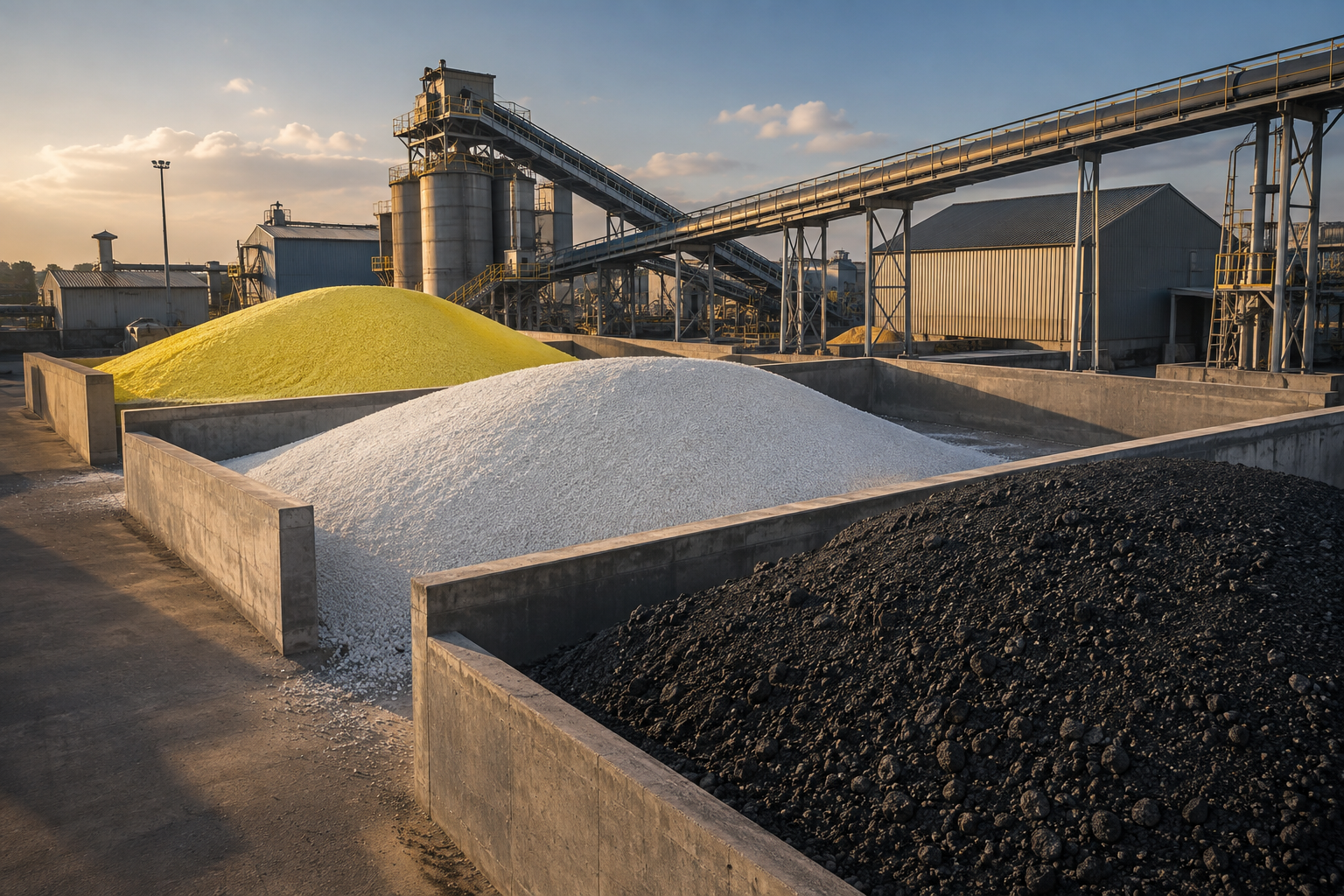
In addition to fuels and energy sources, our refinery and seller partners offer selected industrial products and commodities for various applications and international markets. These include products for construction and infrastructure, the energy and metals industries, chemical processing, agriculture and fertiliser production.
-
Bitumen
A highly viscous petroleum product for road construction, asphalt production and industrial applications. Available in various grades and, depending on the offer, as liquid bitumen in bulk or packaged in Big Bags or Jumbo Bags.

-
Petcoke – Petroleum Coke
A carbon-rich solid product formed during the further processing of heavy petroleum residues in refineries. Depending on grade, petroleum coke is used as an industrial fuel or as a raw material for other industrial applications.
-
Sulphur
Sulphur is an important industrial raw material used, among other applications, in the production of sulphuric acid, fertilisers and chemical products. In international trade, it is offered, for example, as granular sulphur.
-
Urea 46
A highly concentrated nitrogen fertiliser with a typical nitrogen content of 46%, used in agriculture worldwide. Urea is traded primarily in granular or prilled form.
Before your enquiry
Product details.
Business background.
Please introduce your company and your role. Explain whether you are describing a requirement or a potential business opportunity. Where possible, specify the product, the required quantity, your preferred procedure, the intended destination and the desired monthly delivery timeframe.
KRP Energy acts as a mandate holder, not as a producer or a seller trading on its own account. The categories shown here are neither an inventory list nor a binding offer. Specific details, availability and commercial terms are clarified individually for each enquiry.
Please do not send identity documents, bank details or other sensitive documents with your first message.
Contact Jochen Kaminski
Tell us
what you are looking for.
Specify the product and describe your enquiry. If a specification or detail is still to be determined, simply mention this in your message.
info@krpenergy.com
WhatsApp opens an external service in a new tab or in the app.